What does it really mean to know a word?
What does it really mean to know a word?
Many learners treat “I know this word” as a yes/no stamp: I saw the translation once, so I own it. That stamp is comforting — and usually wrong. Knowing a word is a cluster of skills you can strengthen one by one, not a single switch you flip in a dictionary app.
This article is for learners. It gives you a practical map of what “knowing” involves, so you can diagnose weak spots and study with purpose.
The claim in one line
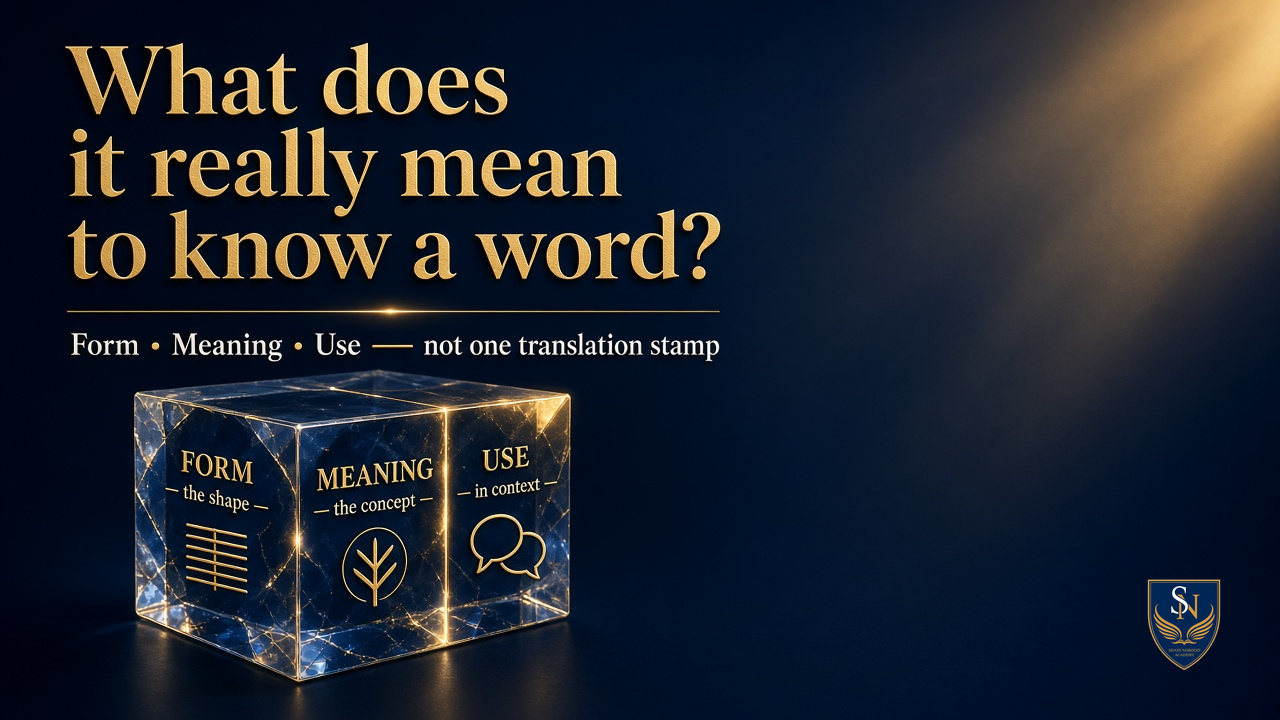
Knowing a word means controlling several linked aspects — form, meaning, and use — in both recognition and production. Seeing a Persian (or L1) gloss once proves almost none of that. Nation’s classic account of “knowing a word” is built around those aspects; Schmitt’s vocabulary teaching overview treats the same idea as a set of knowledge components rather than a single definition (Nation, 2001; Schmitt, 2000).
A learner map: form · meaning · use
Use this table as a checklist when a word “feels familiar” but fails you in reading, listening, speaking, or writing. Pick one word you think you know. Tick what you can actually do — not what you hope you can do.
| Aspect | What “knowing” includes (examples) | Quick learner test |
|---|---|---|
| Form | Spoken form (sounds / stress); written form (spelling); recognizable word parts | Can you recognise it by ear? Spell it without peeking? Spot a related form (e.g. decide / decision)? |
| Meaning | Core concept(s); associations; when several senses exist, which one fits the context | Can you explain the meaning in simple English (or give a precise L1 equivalent)? Choose the right sense in a short sentence? |
| Use | Grammar patterns; collocations; constraints (formal/informal, typical situations) | Can you put it in a natural sentence? Name one partner word it often travels with? Know when it would sound odd? |
Two consequences follow for study. First, translation alone is mostly a thin slice of meaning — and even that slice is incomplete if the word has more than one sense. Second, gaps are normal: many learners recognise a written form in a textbook but cannot retrieve the spoken form in conversation, or they “know” a meaning but never practise the collocation that makes the word usable. Treat those gaps as information, not as failure.
Receptive vs productive knowledge
The same aspects can be stronger or weaker depending on the job you ask the word to do. Receptive knowledge helps you understand when you read or listen. Productive knowledge helps you retrieve and use the word when you speak or write. Recognition is usually easier than recall: you may understand reluctant in a paragraph long before you can produce it under time pressure (Nation, 2001; Schmitt, 2000).
That distinction changes how you practise. Flashcards that only show L1→L2 or L2→L1 test a narrow path. If your goal is listening, you need sound. If your goal is writing, you need spelling plus grammar and collocation under production. If your goal is an entrance-exam vocabulary paper, you still need more than a one-line gloss — many items test form–meaning mapping under distraction, or use in a sentence frame. Size of vocabulary (how many word families you know) matters, but depth on high-value items often decides whether a “known” word actually works when you need it.
A two-minute self-check
Choose one high-value word from your current course, exam list, or reading. Without looking anything up, answer yes/no:
- I can recognise the spoken form.
- I can spell the written form.
- I can state the core meaning in one clear sentence.
- I can use it in a short original sentence that sounds natural.
- I can name at least one common collocation or typical partner word.
Three or more “no” answers means the word is a study target, not a finished stamp. One “no” still tells you where to aim the next five minutes of practice. Keep a tiny log: word · weakest aspect · one action (listen again / write two sentences / collect collocations).
Where this fits next
This post opens the vocabulary branch for learners: what “knowing” means before you argue about methods. Next in the same branch: deliberate study versus incidental learning, then collocation and chunks as usable knowledge. Later, a dedicated post returns to vocabulary size. Separately, Plan 2 builds single-word encyclopedia entries (lemma depth), and Plan 6 GE work leans on the same form–meaning–use map when exam items punish “I saw the translation once.”
Next
S02-V — Deliberate study vs incidental learning
Related (same skill branch)
- S03-V — Why collocations and chunks matter
- Vocabulary size — how many words do you really need? (forthcoming · Day 22)
Cross-plan joins
- Vocabulary Encyclopedia (Plan 2) — one lemma, many senses and collocations (when live, link the entry hub)
- GE / entrance vocabulary (Plan 6) — exam items need form, meaning, and use under pressure (forthcoming)
Sources
- Nation, I. S. P. (2001). Learning vocabulary in another language. Cambridge University Press. https://doi.org/10.1017/CBO9781139524759
- Schmitt, N. (2000). Vocabulary in language teaching. Cambridge University Press.