What language level do you need before teacher training?
What language level do you need before teacher training?
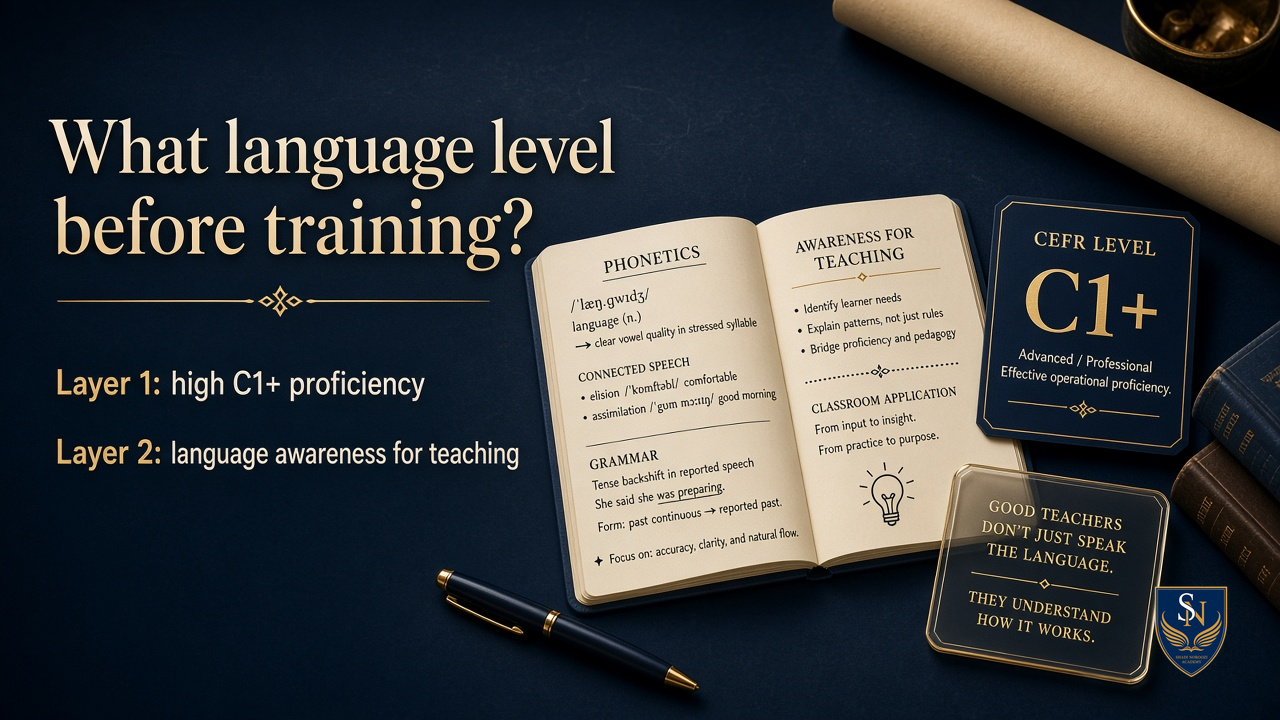
Before a TTC or CELTA-style course, many people ask only one question: What’s my CEFR level? That question matters — and it is incomplete. Cambridge English states that CELTA candidates should be proficient users at high C1 or above, with age and education minima as well. Centres still decide suitability; a language certificate is not always required. Local TTC entry rules vary, but the same trap appears: treating “I speak English” as proof you are ready to teach it.
This hub follows T1 — what TTC is and earlier tips on teaching versus learning and teacher roles. Here the focus is readiness: entry proficiency and language awareness for teaching are two layers.
Layer 1 — Entry proficiency
Published CELTA entry guidance asks for a high C1+ user: you can follow input, join discussions, write short assignments, and teach practice lessons in English without the course becoming a language course about you. If every planning hour is spent decoding materials instead of thinking about learners, the course will feel like survival — the pattern Hobbs (2013) described for short certificates — not like training.
A practical self-check: Can you explain a classroom point in clear English under time pressure? Can you follow peer feedback without constant translation? If not, strengthen language use first; a training stamp will not invent the proficiency the course assumes.
Layer 2 — Language awareness for teaching
The CELTA syllabus Topic 2 — Language analysis and awareness — expects candidates to work with form, meaning, phonology, and useful L1 contrasts, and to use reference tools. That is not “knowing grammar rules by heart.” It is being able to look at an item and ask: What do learners need to notice? What example will make the meaning clear? Where might pronunciation block communication?
Trainee-book style work (early CELTA units) drills this habit before teaching practice: analyse a short item, then plan how you will clarify it. Fluency without that habit leaves you stuck in the explainer role — talking about language you cannot yet unpack for learners.
Two-layer readiness checklist
| Layer | Question | If weak… | 30-second check |
|---|---|---|---|
| Entry proficiency | Am I a high C1+ user for course input, TP, and assignments? | Build language use before (or alongside early) training | Could I teach a 5-minute segment without surviving in L1? |
| Language awareness | Can I analyse form · meaning · pronunciation for one item? | Practise analysis before demo / TP week | Can I write one clear example + one likely learner problem? |
| Both together | Can I clarify under time pressure while learners try the language? | Rehearse short clarify → try-out cycles | After my talk, what did learners do with the item? |
What this means for your course choice
Not every local TTC must copy CELTA’s published bar. Using the two layers still protects you: institutes that enrol weak proficiency without a language plan, or that skip analysis and jump to “methods tips,” sell a stamp without the skill. A stronger pathway pairs honest entry talk with early language-awareness tasks — the same spirit as T1’s distinction between certificate and readiness.
Thirty-second check before you enrol: Do I meet a high-C1-type working level and can I analyse one language item for teaching — or am I hoping the course will invent both?
Series links
Previous: Explainer, involver, or enabler?
Series start: What is TTC, and what is it not?
Next: Real needs vs wishlist (forthcoming)
Next hub: Which teacher-training pathway in Iran? (forthcoming)
Sources
- Cambridge English. (2024). CELTA syllabus and assessment guidelines (July 2024). Topic 2 — Language analysis and awareness. https://www.cambridgeenglish.org/Images/21816-celta-syllabus.pdf
- Cambridge English. (n.d.). What’s in the CELTA course? — minimum entry requirements (high C1 or above). Cambridge English CELTA about page
- Cambridge English. (n.d.). Teaching Qualifications — Recognition FAQs (CEFR expectation; centres assess admission; formal language certificate not always required). Cambridge support article
- Hobbs, V. (2013). ‘A basic starter pack’: The TESOL Certificate as a course in survival. ELT Journal, 67(2), 163–174. https://doi.org/10.1093/elt/ccs078
- Series mother: T1 — local TTC / TKT / CELTA. Open T1