· Updated October 30, 2026
Explainer, involver, or enabler?
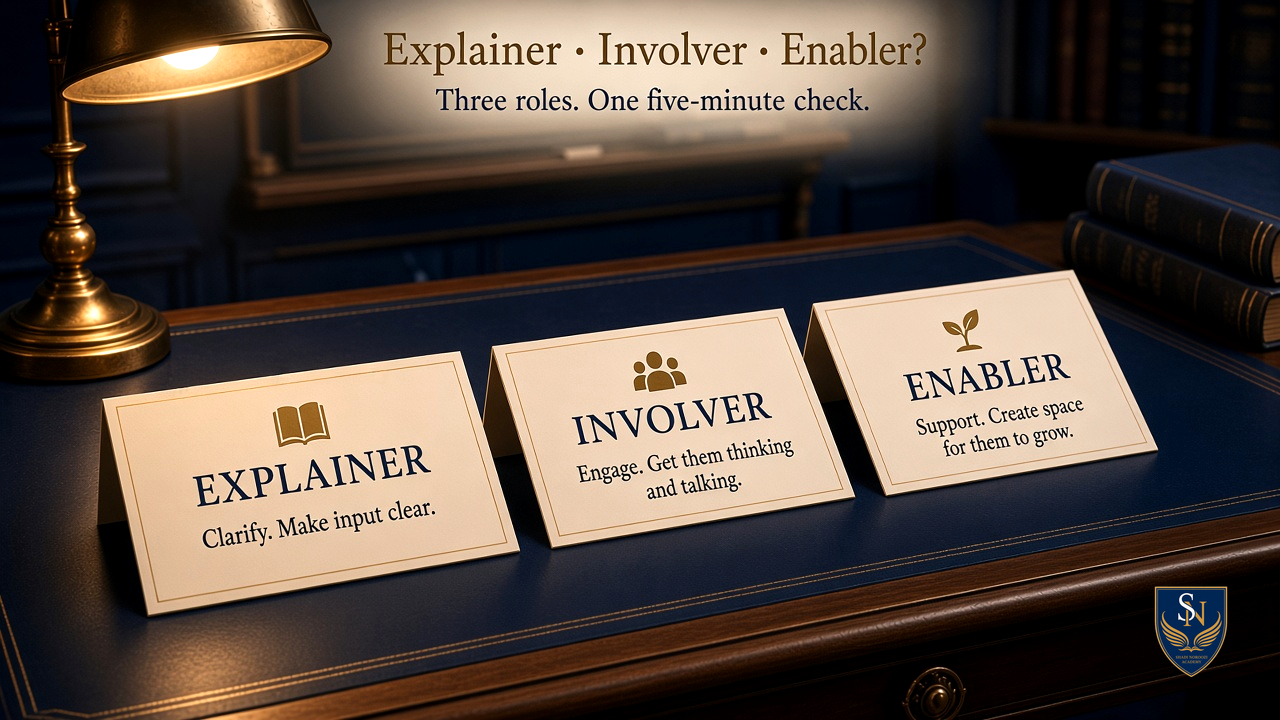
Explainer, involver, or enabler?
In Day 2 we used Scrivener’s formula — teaching does not equal learning — and asked how many minutes learners actually used the language. Day 3 names three roles from the same chapter of Learning Teaching: explainer, involver, and enabler. They are a check for your next lesson segment, not a personality costume you wear forever.
This tip sits under T1 — what TTC is and is not. Early local training often pushes “explain clearly.” That skill matters. Alone, it can freeze you in the explainer role while learners stay quiet.
Three roles, one chapter
Scrivener (2005, Chapter 1) sketches three broad kinds of teacher. They are simplifications — useful for seeing patterns, not for ranking people as good or bad.
The explainer knows the subject well but leans mainly on telling: lectures, board work, long clarification. Learners mostly listen and take notes. Methodology knowledge is thin; explanation feels like “the teaching.”
The involver also knows the language, but adds methodology: varied activities, clear organisation, techniques that pull learners into work. Explanation is one option among many. The teacher still keeps clear control of the room and the sequence.
The enabler knows subject and methodology, and also watches how individuals and groups think and feel. Control is often shared or negotiated. The job is to create conditions so learners can learn for themselves — sometimes as guide, counsellor, or resource; sometimes almost invisible when autonomous work is running well.
Diagnostic table: which role dominated?
| Role | What the teacher mainly does | Control | Risk for language use | Check question |
|---|---|---|---|---|
| Explainer | Tells, clarifies, boards the point | Teacher holds almost all of it | Long listening; little try-out | After my talk, what did learners do? |
| Involver | Designs tasks that pull learners in | Teacher steers; learners are busy | Activity without real language aim | Were learners working with the target language? |
| Enabler | Sets conditions; responds to people | Shared / negotiated when useful | Chaos if aims and support are unclear | Could they work with less of my talk? |
Most teachers move between roles in one lesson. A short, sharp explanation can be the right move. The problem is when every minute defaults to explainer — the pattern Day 2 called “traditional transmitter.”
A practical move for TTC trainees
After one lesson segment (or a micro-teach), label which role dominated for five minutes. Then redesign one minute only: keep the clarity you need, but shift toward involver (a pair check, a short try-out, monitoring) or, when the class can carry it, toward enabler (learners choose an example, peer support, you step back).
Scrivener notes that many trainees start with an internal image of the explainer and aim to become involvers. That move is a fair training goal. Enabler skills — reading the room, sharing control wisely — grow with experience; they are not a slogan for day one of a short course.
What this means for your course
If a TTC only rehearses beautiful explanations and never asks which role ran the clock, it sells the stamp without the skill. A stronger pathway — local or CELTA-informed — keeps pairing language awareness with observation of learner work, as T1 already argued.
Thirty-second check: in this segment, was I mostly explainer, involver, or enabler — and did learners use the language more than they heard about it?
Series links
Previous: Day 2 — What does a good teacher actually do?
Mother: T1 — What is TTC, and what is it not?
Next FULL in the month: T2 — What language level do you need before training?
Sources
- Scrivener, J. (2005). Learning Teaching (2nd ed.). Macmillan. Chapter 1 — explainer, involver, and enabler roles (also framed in later editions under “Starting out”).
- Previous tip: Day 2 — teaching ≠ learning and conditions for learner use. Open Day 2
- Series mother: T1 — local TTC / TKT / CELTA. Open T1